 Intent
The teaching of Maths has a high priority throughout Albrighton Primary School. We believe that Maths is a journey and long-term goal as children acquire new skills and knowledge through exploration, clarification, practice and application over time. Our maths curriculum is designed to develop fluency, reasoning and problem-solving skills, following a mastery approach that ensures all children, regardless of background or ability, are secure in mathematical understanding before moving on. We acknowledge that particularly early on, children need to be taught number facts and develop fluency in recalling these facts. Our pupils relish the opportunity to apply this knowledge in rich problem-solving contexts. At each stage of learning, pupils will be able to demonstrate a deep, conceptual understanding of the topic and be able to build on this over time. We are dedicated to developing an environment where pupils are able to transfer and apply their maths skills across the wider curriculum, often within real life contexts.
We intend to do this by:
- Ensuring our children have access to a high-quality maths curriculum that is both challenging and engaging.
- Providing our children with a variety of mathematical opportunities, which will enable them to make the connections in learning needed to develop a greater depth in learning.
- Ensuring children are confident mathematicians who are not afraid to take risks.
- Fully develop independent learners with inquisitive minds who have secure mathematical foundations and seek to do their best.
Implementation
Our mastery approach to the curriculum is designed to develop a rich and deep subject knowledge and understanding of mathematical concepts from the Early Years through to the end of Y6.
- In school, we follow the National Curriculum and use White Rose Schemes of Work as a scheme of learning to support teachers with their planning and assessment.
- The calculation policy is used within school to ensure a consistent approach to teaching the four operations over time.
- At the start of each new topic and in each lesson, key vocabulary is introduced and revisited regularly to develop language acquisition, embedding as the topic progresses.
- Children are taught through clear modelling.
- Pupils showing a secure and deep understanding within a unit will be given opportunities to broaden and deepen their learning through rich challenge tasks that promote reasoning and application in new contexts.
- Reasoning and problem solving are integrated into lesson activities, where appropriate, to develop their mathematical thinking.
- Dedicated problem-solving lessons provide all children with opportunities to apply their skills, reason mathematically, and use oracy to explain and challenge their thinking.
- Pupils are encouraged to reflect on their learning, discussing strategies and evaluating their approaches to deepen understanding.
- We value fluency in recalling facts, and time is specifically allocated for this through the Mastering Number program.
- Resources underpin learning of the different skills appropriate for each year group.
- Children with additional needs are included in whole class lessons and teachers provide scaffolding and relevant support as necessary. For those children who are working outside of the year group curriculum, when appropriate, individual learning activities are provided to ensure their progress.
Planning and Delivery
In order to provide a coherent curriculum, every year group follows a progression document that outlines the key learning of each area of mathematics such as fractions which will be taught throughout the year. This ensures that adequate amount of time and coverage is allocated to each key area. White Rose schemes of learning support teachers to plan a sequence of progressive weekly lessons over time, giving the children time to master new concepts. Within this document, key objectives, knowledge and vocabulary are outlined with fluency, problem solving and reasoning opportunities evident. Progression documents and the Calculation policy, used to support the White Rose scheme, ensure that staff are delivering a consistent, progressive and challenging curriculum.
Teachers short term planning is developed using the White Rose long-term overview and termly progression document to ensure all areas are taught. This planning includes assessment for learning opportunities, the learning objective for each lesson, linked success criteria and tasks to meet the objective. With the support of White Rose materials, regular CPD and the use of the calculation policy, teachers have expert knowledge on how to teach key concepts. Models & images are used effectively to help pupils visualise the mathematics being taught.
Within the lesson, teachers check pupils understanding effectively and address any misconceptions swiftly. The curriculum is designed and delivered in a way that allows pupils to know more and remember more. Children are given opportunities to practise and apply new knowledge and skills fluently before moving onto reasoning mathematically and solving problems. Children who are more likely to struggle or who are at risk of falling behind are given more time to complete tasks so that they can commit core facts and methods to long-term memory. All children are given regular opportunities to develop mathematical thinking.
EYFS
At Albrighton Primary School and Nursery, we believe that a deep and secure understanding of number in the Early Years lays the foundations for all future mathematical learning. Our approach focuses on developing children’s fluency, reasoning, and problem-solving through rich, practical, and playful experiences that make maths meaningful and enjoyable.
We place particular emphasis on exploring smaller numbers in depth, enabling children to truly understand the value of each number, the relationships between them, and how they can be composed and decomposed in different ways. This depth of understanding equips children with the skills they need to manipulate and make sense of larger numbers as they move through the key stages.
Children are encouraged to notice and explore numerical patterns and the relationships between quantities and digits, supporting them to think mathematically and develop a strong sense of number. Through hands-on exploration, talk, and reasoning, children build confidence, curiosity, and a positive attitude towards maths that will support them throughout their learning journey.
Assessment
Formative assessment within every lesson helps teachers to identify the children who need more support to achieve the intended outcome and who are ready for greater stretch and challenge through planned questioning or additional activities. Interventions are planned (in addition to Maths lessons) for those children who are working below expected levels enabling them to make rapid progress. To support teacher judgments, children are assessed using NFER tests in line with the national curriculum for maths on a termly basis. Year 6 Children are assessed using previous years SATs papers. Assessment results will inform future teaching and help identify children who may require additional support or intervention. For each topic, teachers conduct a Pre-Unit Assessment to gauge pupils’ prior knowledge and understanding from previous learning, and a Post-Unit Assessment to evaluate whether all pupils have met the learning objectives for the topic.
Developing Fluency
Children in Reception, KS1, LKS2 and Year 5 participate in the NCETM Mastering Number Programme. This programme aims to secure firm foundations in the development of good number sense and the aim over time is that children will leave KS1 with fluency in calculation and a confidence and flexibility with number. In KS2 the aim is for pupils develop fluency in multiplication and division facts. Pupils build a confidence and flexibility with number that exemplifies good “number sense” when dealing with multiplicative relationships. Teachers develop their understanding of how pupils progress in multiplicative concepts. Additional time outside of the main Maths lesson is provided for this.
From Y2, times tables are taught through mental oral starters, with additional opportunities for children to access Times Tables Rockstars, in school and at home. In KS2, times tables as well as other arithmetic skills are practised during arithmetic lessons. Children are able to practice times table skills through Times Tables Rockstars and 10Ticks. This enables the children to have rapid and accurate recall enabling them to apply this knowledge to more complex problems.
Impact
Our children enjoy maths and show a high level of pride in their work. They achieve their full potential in maths. and are ready to move on to the next stage of learning, with the necessary age-related knowledge and skills. Children demonstrate a quick recall of facts and procedures, including the recollection of the times table facts. They can show their understanding in multiple ways, using the mathematical language to explain their ideas, and can independently apply the concept to new problems in unfamiliar situations. Pupils are resilient learners who have acquired a thirst for knowledge and the confidence to take risks.
Please find our Maths policy below:
Maths Policy October 2025
Please find our Maths SMSC Statement below:
Maths SMSC Statement
Our calculation cycle shows the range of mental and written strategies that are taught in order to build childrens’ skills and knowledge. This informs the teachers of the agreed sequence and progression of methods for calculation from EYFS to Year 6.
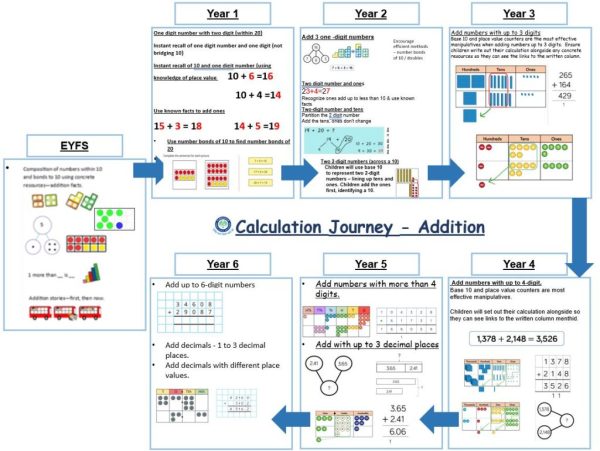
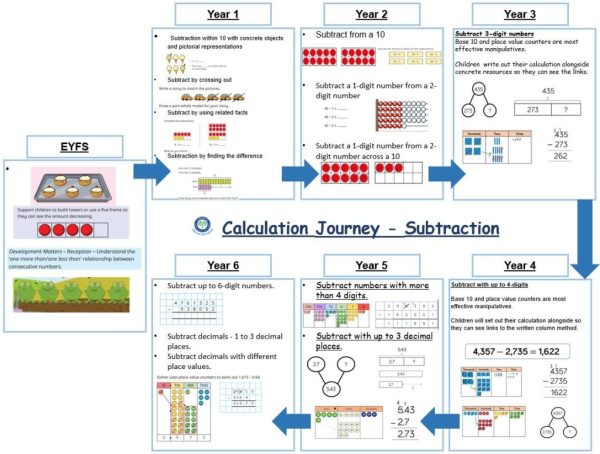
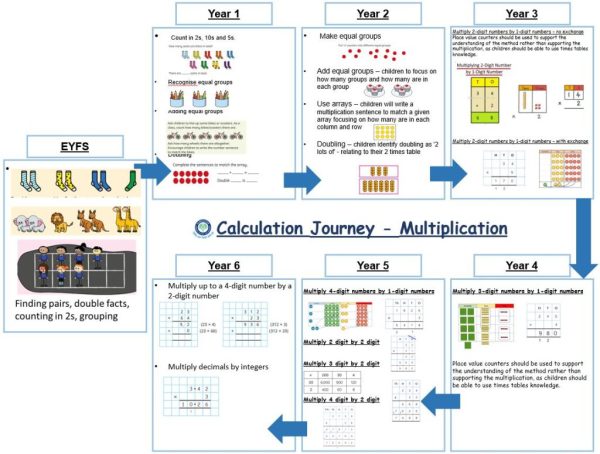
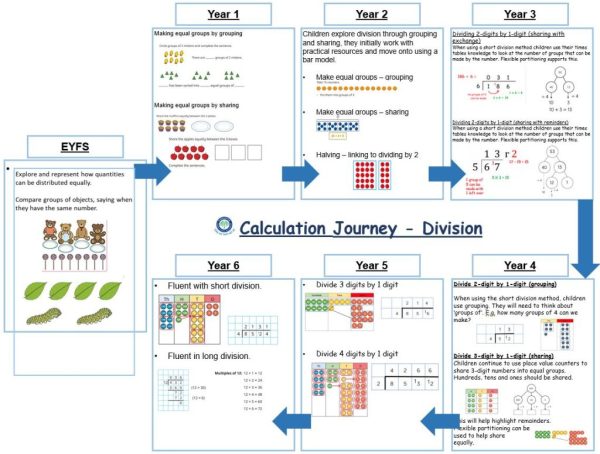 Calculation Progression
Calculation Policy – ASMD
Number formation
We have developed our own set of number formation rhymes, linked to the Number Blocks characters we use in Mastering Number. These rhymes are used consistently across the school to embed the solid foundations of number formation.
Albrighton Number Formation Rhymes
Children revisit regularly and embed all mathematical concepts by following our Mathematical curriculum. See example for Year 2 below:
Y2 curriculum overview
Teachers use progression documents across the school to ensure coverage of the Maths curriculum and opportunities for revisiting previous learning. See an example for Year 4 below:
Year 4 – Progression Document
The aims of the National Curriculum are to develop fluency and the ability to reason mathematically and solve problems.
Reasoning
At Albrighton, Reasoning is a key element of our Maths lessons. We develop opportunities and ensure progression in the development of reasoning skills
We recognise that the ability to reason mathematically is an important factor in a pupil’s success in mathematics. Therefore, we ensure that opportunities to develop mathematical reasoning skills are integrated fully into our Maths curriculum. Such skills support deep and sustainable learning and enable pupils to make connections in mathematics.
Reasoning progression
Problem Solving
We have identified the most useful problem-solving strategies that pupils need to learn. We have created a structured programme that is planned for pupils to gain familiarity with problem types so that they can easily identify strategies to use.
This enables our pupils to see and learn the commonalities and differences of the problem type, so that they acquire the ability to see past the surface features of linked, novel problems and to the deep structure. Through accessing similar problems, they have the opportunity to purposefully practice their problem solving skills.
Problem Solving Progression
Helping at Home:
There are lots of ways parents can support their children with their Maths learning at home. ‘Talking’ and ‘doing’ Maths at home, whilst using the appropriate language can really help your child to develop understanding around key mathematical concepts. The following leaflets offer ideas for ways to enjoy Maths activities at home and thereby support your child’s progress.
Year 1 and 2
Year 3 and 4
Year 5 and 6